“Social isolation and loneliness are leading concerns in our community. The opportunity for our riders to share their stories with us is one of our guiding principles. Storytelling is healing. We …
This item is available in full to subscribers.
To continue reading, you will need to either log in, using the login form, below, or purchase a new subscription.
If you are a current print subscriber, you can set up a free website account and connect your subscription to it by clicking here.
Otherwise, click here to view your options for subscribing.
Please log in to continue |


“Social isolation and loneliness are leading concerns in our community. The opportunity for our riders to share their stories with us is one of our guiding principles. Storytelling is healing. We don't take that lightly. Our pilots show up, they listen to stories that have been told a hundred times and laugh like it’s the first time,” said Matthew Stepaniak, co-founder/director of Limitless Cycling.
Limitless Cycling, the Signature Program of River Valley Trails, has been recognized with St. Croix Economic Development Corporation’s inaugural 2025 County Impact Award for its positive impact on community health and connection.
“To St. Croix EDC, thank you for recognizing that longing, mental health and inclusion are economic issues because thriving communities require connected people,” Stepaniak said.
For Stepaniak, bicycling is both literally and figuratively the means to fulfilling Limitless Cycling’s mission, “to improve the mental and physical health of seniors, veterans, and people with developmental disabilities and cognitive challenges who cannot bicycle independently by providing them with piloted rides on adaptive bicycles and Trackchairs.”
Stepaniak is honest about his for-profit roots. Schooled as an architectural draftsman, he built his career managing in the automobile collision industry. “I tended to take a very direct approach focused on solving problems and moving things forward,” he said.
The death of his father in 2014 and subsequent care of his mother following her stroke in 2018 opened his eyes to the challenges of caregiving and changed his life.
While recovering from her stroke, Matthew’s mother, Nancy, expressed her desire to get back on her old three-speed bicycle. Matthew and his wife, Tawnya, supported the idea of bicycling, just not on the old three-speed.
Limitless Cycling uses various configurations of electric-assist three-wheeled bicycles manufactured by the Dutch company vanRaam. The bikes are specially adapted for Limitless passengers’ unique needs. Generally, the pilot pedals and steers from the rear while the passengers sit up front.
Matthew and Nancy’s first ride on their adaptive bicycle ultimately proved the concept that would become Limitless Cycling. “We didn't get very far because people kept stopping us and asking questions. ‘What is this? Who are you? Do you do this for other people?’” Stepaniak said. “We realized very quickly that the need was much greater than my mom. There were individuals like her, young and old, veterans, individuals with developmental disabilities, and cognitive challenges that needed help getting back outdoors.”
Darren Dobier, a long-time friend and collaborator, operates DIRO Outdoors. DIRO shows up at designated locations, such as Willow River State Park, on a designated date for a limited period of time, loaded with gear for rent, including snowshoes, fat-tire bikes, paddleboards, and kayaks.
Stepaniak and Dobier also volunteered at River Valley Trails, a 501(c)(3) focused on partnering with local groups to develop interconnected trails across the St. Croix River Valley while promoting education and connectivity in cycling.
In 2019, Dobier and Stepaniak co-founded Limitless Cycling as the Signature Program of River Valley Trails. Stepaniak adopted Dobier’s mobile deployment model: Limitless would use adaptive bicycles to expand beyond able-bodied riders to serve seniors, veterans, and those with mobility challenges.
Next, he partnered with River Valley Trails, leveraging their 501(c)(3) status as a fiscal sponsor, and affiliating the organization with "Cycling Without Age” to further their grassroots effort to connect the community through cycling.
Stepaniak prioritized helping seniors, veterans, and those facing mobility challenges from the outset. He understood that reclaiming a sense of independence, whether for five minutes or five miles, helps combat loneliness and the mental health struggles that come with social isolation.
“A stroke, PTSD, dementia, mobility limitations, or cognitive challenges can quietly shrink someone’s world from miles to hallways. Trails they once walked become something they can only see through a window,” Stepaniak explained. “Our pilots navigate roots and river paths so someone can feel the wind on their face again. When a rider says, ‘I never thought I’d be out here again,’ you can see something return: confidence, dignity and connection.”
In Spring 2022, Limitless implemented a strategic change and began meeting seniors at their senior living facilities. “By partnering directly with senior living facilities, we eliminated many of the barriers that had previously limited participation—transportation, staffing coordination, and uncertainty around safety,” Stepaniak said. “Facilities already had deep relationships with their residents, and once those partnerships were established, participation followed naturally.”
When it comes to everything but pedaling, Limitless is a one-man show. As such, Stepaniak relies on strategic partnerships, expert guidance, analytics, and grassroots feedback from riders and their care teams to plan Limitless’s path forward. He realized “as able-bodied, able-minded individuals, we cannot know what our passengers' lived experience is like. We need to have them sitting at our tables.”
Riders and their care teams pointed out an obvious shortcoming - the seasonality of services. It drove Stepaniak's decision to invest in Trackchairs. “Our name has 'limitless' in it, and all of a sudden we were limited. Darren and I took that personally,” Stepaniak recalled.
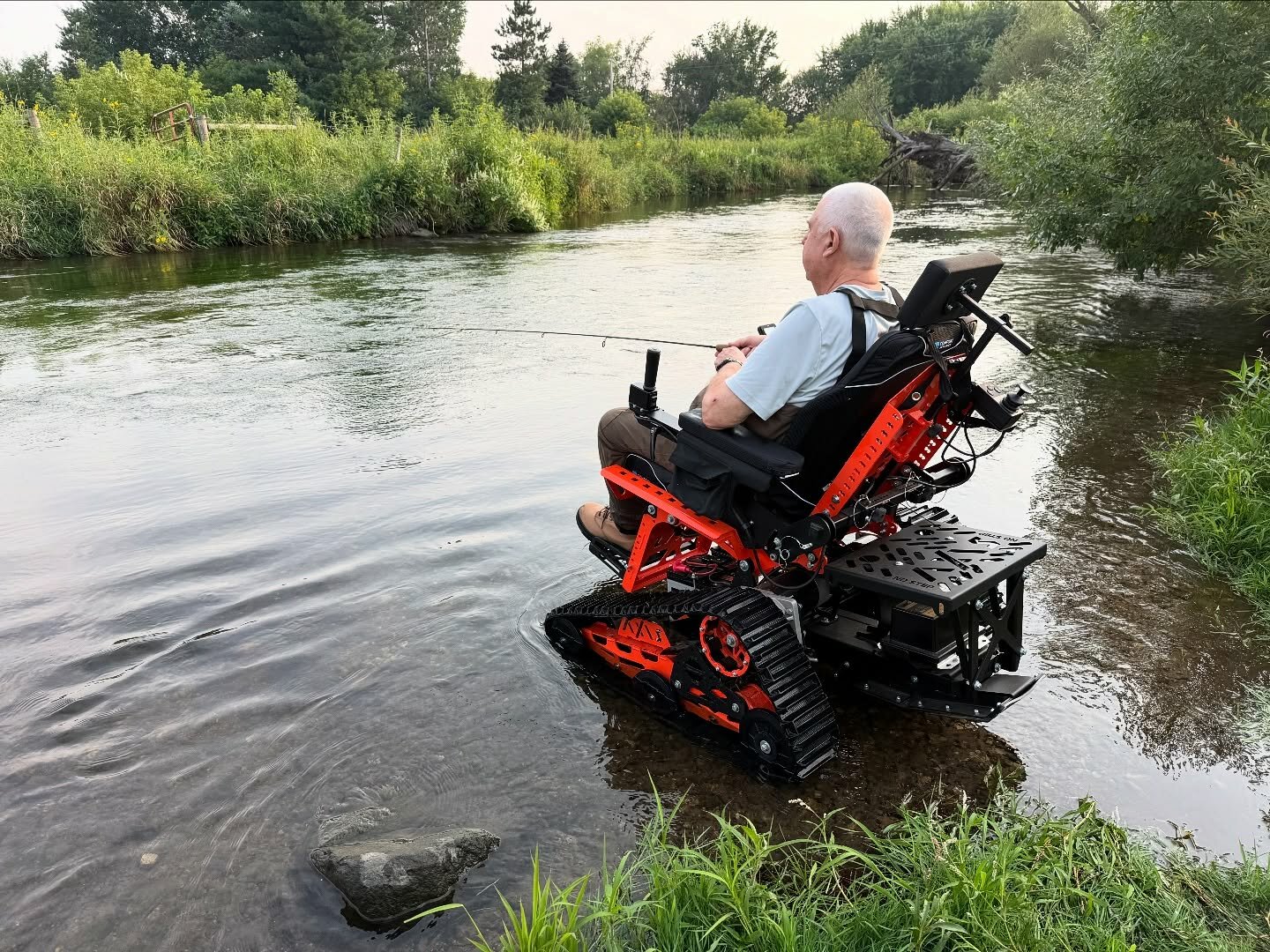
With seven adaptive bicycles already in the stable, Stepaniak began planning for the purchase of Trackchairs in 2022, which would enable Limitless to provide rides year-round. Trackchairs also extended the program's reach to individuals with more significant mobility challenges and expanded its off-road capabilities, reaching a new segment of riders, including hunters and fishermen.
Trackchairs are autonomously controlled track-driven wheelchairs.
Rides are free, so at roughly $22,000 per chair, it was a sizable investment. Limitless relies on four primary funding sources: donors, grants, sponsorships, and fundraisers. Thinking sustainably and developing strategic partnerships combined with the program’s surprising growth has put Limitless two years ahead of its capital projections. That acceleration enabled Stepaniak to add four Trackchairs to his inventory.
The investment paid off; in 2025, Limitless provided more than 800 rides. “Everything we do is based on the generosity of our community. Our funders, our sponsors and our grants are given because we do not charge individuals for what we do,” Stepaniak said.
Pilot-passenger relationships are the lifeblood of the Limitless experience, and since that experience is driven by the passenger, Stepaniak is selective when it comes to finding volunteers to pilot. “Anyone can pedal a bike, but not everyone can be a pilot,” he said. “We invite those who have the ability to see the world through other people's eyes.”
Limitless riders range in age from 5 to 105 and span a wide spectrum of physical and cognitive challenges.
Ironically, for a business built on cycling, the concept of “slowness” is fundamental to its success. Stepaniak explained that slowness is more than the pace of the bike; it also guides how a pilot interacts with his passenger with patience, dignity, and respect.
“We listen first. Fast talk at a high volume might cause them to withdraw. We pay attention to our rate of speed, our gaze, and the temperature of our voice. We always want to be meaningful, not remedial,” he said.
Rides proceed at the speed of a brisk walk, allowing family members or other care team members to accompany a rider if desired. The riders' and care team's needs and expectations are communicated in advance, ensuring a safe and meaningful ride.
“We may only have 5 minutes together, but it means the world to them. They’re not going to talk about anything else but those 5 minutes they were on the bike with us,” Stepaniak said. “We're going to do it respectfully and with all the dignity that they deserve to honor whatever part of the journey they're on in their lives.”
Recent policy shifts away from diversity, equity and inclusion (DEI) run contrary to the inclusive culture Limitless strives to build. “We feel that diversity enriches us, equity drives us and inclusion strengthens us,” Stepaniak said.
He also believes in accessibility and belonging. Whether it is affordable housing, healthcare, food security or just getting outside, it is all connected, and access to it empowers everyone. “Once we create access with our mobile delivery, we create a bridge for individuals in our community, proving that disability does not mean exclusion. Inclusion becomes visible,” Stepaniak explained. “Strong communities are not defined only by economic growth but by whether people feel they belong in the life happening around them. When they are seen, and they are felt, they matter.”
The government shutdowns have impacted Limitless’ funding. Stepaniak acknowledged that grantors needed to be focused on funding basic needs first. “What we do is amazing, but it's not going to help someone pay their mortgage or pay for food. Basic needs need to be the priority right now,” he said.
Compassion is the currency of non-profits.
Limitless finds itself in the position of wanting to grow and needing to invest in capacity and management to get there. Stepaniak is seeking a solution that preserves Limitless’ community-first identity and keeps the service free for those who cannot afford it. With donors and grantors redirecting their philanthropy elsewhere, he has seized the moment to consider new revenue streams including a fee-for-service option.
What Stepaniak fears is having to overcome the perception that a non-profit operating with a 60/40 program cost-to-overhead cost ratio is just as legitimate and can be just as effective as one operating with an 80/20 ratio.
Stepaniak believes non-profits should be able to pay staff wages competitive with comparable for-profit staff positions and spend meaningful money on marketing without being penalized in the eyes of donors and grantors who prefer low overhead and high efficiency, even when it limits long-term organizational growth and effectiveness.
“Nonprofits as a whole need to be celebrated when we create an opportunity for growth just as much as for-profit businesses do,” he said. “If we can offset our overhead costs while allowing us to grow by charging those who can afford it to offset those who cannot, that would be our big picture, but to do that, we’ll need to figure out how to live in two worlds at the same time.”