Ellsworth asks for help in demo of old junior high By Sarah Nigbor The City of Prescott and the Village of Ellsworth both made presentations to the Pierce County ARPA Ad-Hoc Committee June 21, hoping …
This item is available in full to subscribers.
To continue reading, you will need to either log in, using the login form, below, or purchase a new subscription.
If you are a current print subscriber, you can set up a free website account and connect your subscription to it by clicking here.
Otherwise, click here to view your options for subscribing.
Please log in to continue |
The City of Prescott and the Village of Ellsworth both made presentations to the Pierce County ARPA Ad-Hoc Committee June 21, hoping for a piece of the $8.3 million pie for projects they consider vital to their respective communities.
The Pierce County Board Ad-Hoc Committee’s purpose is to figure out how to appropriate the county’s $8.3 million in awarded American Rescue Plan Act funds The U.S. Department of the Treasury is responsible for the funds’ distribution. Four broad eligible uses for ARPA funds include: Revenue replacement for government services COVID-19 expenditures or negative economic impacts from COVID-19, including assistance to small businesses, households, hard-hit industries and economic recovery.
Premium pay for essential workers. Investments in water, sewer and broadband infrastructure City Administrator Matt Wolf and Mayor Rob Daugherty spoke about the City of Prescott’s need to address high nitrate levels in the city’s Well No. 3. They are hoping the county will agree to pick up a portion of the $1,023,175.50 bill and are asking for $260,909.75.
“We are required by the DNR to regularly test our wells and we got a test back of 12.1 milligrams / liter for nitrates,” Wolf said.
Citizens had to be notified and the well taken offline in September 2021 because the DNR’s allowable nitrate level is 10 mg/l. Currently, the city is using its other two wells but doesn’t feel that is sustainable due to Well No. 2’s age.
“The DNR requires us to remediate that well (3), to come up with an action plan to bring that well back online,” Wolf said.
The city hired CBS Squared to look at options and believes the most feasible option is treating the well through a reverse osmosis system. Other options considered were digging a deeper well in the same location, tunneling under the Mississippi to hook up to Hastings’ (Minn.) water system or digging a new well in Prescott.
“Going deeper you don’t know if you will get away from the nitrates,” Wolf said. “What is the best way to fix or remediate that issue long-term? We decided to move forward with reverse osmosis.”
According to Wolf’s proposal, reverse osmosis treatment removes a broad range of contaminants, including nitrates, arsenic, hardness, radium and microbial contaminants.
“The processes do not usually require adjustment based on the specific trace contaminants present,” the proposal states. “It is recognized by the EPA (Environmental Protection Agency) as an effective treatment for PFAs, which is also important to the city in case of future need.”
The project’s total cost is estimated at $1,023,175.50, of which the city is asking the county for $260,909.75. The city is also applying to the Wisconsin DNR Safe Drinking Water Loan Program, which is targeting a 49% loan forgiveness rate. If the city receives that rate, that would leave 51% ($521,819.51) to be paid. The city is asking the county for half that amount; the other half would be paid by the city’s ARPA funds, which total $449,000.
“The City of Prescott believes it is extremely important to provide our citizens safe drinking water,” the application states. “Due to aging infrastructure and long-term consequences of chemical leeching into the aquifer, we believe it is the best decision to look at long-term treatment of Well No. 3. This solution creates a long-term benefit as it provides the city and county with an investment that will support growth and improved drinking water for our residents.”
Further, if the county contributes a portion of its ARPA funds to the project, the city could avoid needing to increase its water rates.
“This does affect a wide variety of constituents,” Wolf said. “PFAs are starting to be on the DNR’s radar as well. As we move forward, I think treatment and remediation is going to become more and more of an issue for other communities as well.”
Chair Jon Aubart asked how many people receive their water from Well No. 3, but Wolf said it’s impossible to tell because the wells are cycled. Two are used at all times to make sure proper blending is occurring. “The wells were cycled every other week or monthly,” Wolf said. “We are looking at moving to a daily system.”
Wolf explained being down one well is also a strain on water demand, especially on Well No. 2, which is an “old well.”
“One of the things we’re worried about is how long Well No. 2 is going to last,” Wolf said. “If there is any breakdown or a need to take one offline, two will not meet demand.” According to Wolf, the city hasn’t appropriated all of its $449,000 in ARPA funds yet. City Council is hoping to use part of the funds to increase safety measures in down- town (security cameras, etc.) due to the influx of Minnesota residents who flock to the bars. The Safe Drinking Water Loan Program application is due this week, along with a design plan from CBS Squared. The DNR and Public Service Commission will have three to six months to review the application and proposal. The PSC will also evaluate how the project cost may affect city water rates. “We are hoping to relieve the burden of a potential water rate (to residents and businesses) increase by paying more upfront,” Wolf said.
The loan program would require the project to be complete by the end of 2023. County Administrator Jason Matthys said the EPA is changing its regulations related to nitrates, possibly brining the threshold down even further. The new rules will be released in October, Wolf confirmed.
Revitalization of 254 S. Chestnut St.
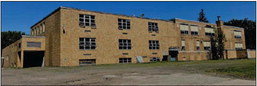
The Village of Ellsworth has embarked on a project to demolish and revitalize the former Ellsworth Junior High building, a blighted and undertaxed property located at 254 S. Chestnut St. Village President Becky Beissel, joined by trustees Mindy Anderson, Andrew Borner, Tony Hines and Dale Hines, appeared before the committee.
“Your investment can solve several critical issues in the community while contributing to economic development,” Beissel said. “This property has been the elephant in the community for several years.”
The village, which is going through its comprehensive planning process, has identified the 2.35-acre parcel as a viable spot to build affordable workforce housing, once the structure is demolished. Out of 628 respondents to a January community survey, 56% felt single-family housing is needed; 42% identified affordable housing as a need; 38% said townhomes or duplexes are needed; and 5% said no new housing is necessary.
“The school district sold the property for $1 in 2005 in good faith that it would become a dinner theatre, then sold to a close-out warehouse company (where it was later condemned, with 16 tons of rotting food inside), then sold to the current owners who are using it as a salvage storage facility,” Beissel wrote in a letter to community members.
The village has entered into a purchase agreement for the property in the amount of $25,000. The sale will close Aug. 1. The next steps in the process to develop the property are preparing demolition plans and specifications, asbestos removal, hazardous materials inspection, and the actual demolition itself, estimated to cost $943,530.
Along with her presentation, Beissel provided letters of support from Ellsworth Chamber Executive Director Kim Beebe, Superintendent Barry Cain, Ellsworth Area Ambulance Director Jessi Willenbring, Public Health Officer AZ Snyder, and Ellsworth Cooperative Creamery CEO Paul Bauer.
“The property was once the property of Ellsworth Community School District,” Cain said. “At the time of the sale of the property, the previous board chose to sell the property to private ownership rather than spend taxpayer funds for the demolition of the property. There was a general feeling in the community at the time that this was the best decision to make. Unfortunately, the property has become a liability for the community rather than an economic benefit.” The building is beyond saving due to water intrusion, mold, broken windows and a leaking roof, Beissel said. In her letter, Willenbring said adventurous people climb on the roof and through the windows; she would hesitate to send her crew inside due to safety concerns.
“This our opportunity to finally act on this problem and ensure it won’t continue its checkered past,” Dale Hines said. “We can’t risk it falling into the hands of people who can’t afford to keep it up.” Ellsworth, as well as Pierce County, has a severe lack of housing of all kinds, Beissel pointed out. Employers are challenged by the lack of middle or workforce housing.
“Recruiting and retaining talent without sufficient and suitable housing stock has led to continued hiring challenges and turnover issues,” Bauer said. “Sixty percent of our Ellsworth facility employees reside outside of the 54011 zip code, and many reside out of Pierce County. This is not by choice; it is due to the lack of rentals and starter homes in Ellsworth and the surrounding communities.”
Access to healthy and affordable housing is an urgent local public health issue, Snyder said.
“Ellsworth is in desperate need of housing opportunities for young families and single professionals,” Snyder wrote. Workforce housing offers more opportunities to recruit talent to serve Pierce County, including nurses, teachers and police officers. Housing stability, quality, safety and affordability all affect health outcomes, as do physical and social characteristics of neighborhoods.”
Currently the property generates $761.77 annually in taxes for the county. If a small bungalow court or pocket neighborhood of townhomes were built (totaling 26 units), it could provide an additional $5 million to $5.8 million in tax value within the county, $98,000 to $120,000 in additional annual tax base and $2.9 million in additional household spending infused into the economy, the proposal states.
The village is researching creating a blighted Tax Increment District for the property. However, taxes will be generated sooner if no TID is needed. If the county agrees to appropriate some ARPA funds, the village and county can realize the increase in tax base sooner.
Aubart questioned the wisdom of purchasing a building that was sold in 2005 for $1 for $25,000 now.
“Buying a pile of junk for $25,000 that’s going to cost $1 million to tear down, doesn’t make a lot of sense,” he said.
Dale Hines said the current owner bought the property for $25,000 from the failed dinner theatre.
“We wanted to stop and clean this up,” Hines said. “We didn’t want another organization or person with a crazy dream to acquire it and kick the can down the road on the problem.
We didn’t want to pay the money either but we didn’t want to insult the previous owner to the point where he would just tell us to take a hike. We didn’t want to spend the money but we did it in a purposeful way.”
The village received $350,000 in ARPA funds and will use $25,000 of that to buy the building. The rest hasn’t been allocated yet, but the village is looking at needing to expand its wastewater treatment plant.
Aubart said the county has received requests for ARPA funds totaling about $30 million.
“All the projects are good projects, but there’s going to be some hard choices to be made, but that’s what we’re tasked to do,” Aubart said. “I’m looking for the most bang for our buck, essentially. I’m not saying no or yes either way, but just to be up front about what we’re faced with when we start looking at these projects.” The ARPA AD-Hoc Committee next has a meeting scheduled at 10 a.m. July 19.