Goal is to reconnect with horse ancestors TOWN OF GILMAN – For Em Loerzel, the Lac La Croix Indian ponies she’s caring for aren’t just animals or tools: They are her family members, family to …
This item is available in full to subscribers.
To continue reading, you will need to either log in, using the login form, below, or purchase a new subscription.
If you are a current print subscriber, you can set up a free website account and connect your subscription to it by clicking here.
Otherwise, click here to view your options for subscribing.
Please log in to continue |
Goal is to reconnect with horse ancestors
TOWN OF GILMAN – For Em Loerzel, the Lac La Croix Indian ponies she’s caring for aren’t just animals or tools: They are her family members, family to the entire Ojibwe nation. And when she adopted six of the remaining 180 left in the world, it was like being reunited with long-lost relatives.
“In my early 20s, one of my uncles would tell stories about how when he was a kid, there were small horses who would live in the woods,” Loerzel said. “One day they all disappeared.”
In the 1970s, the Canadian and United State governments collected the remaining horses and exterminated them. Some were made into dog food and glue. They were considered a public nuisance, Loerzel said.
“They didn’t consider them useful,” Loerzel said. “They weren’t big, they weren’t draft horses.”
The Ojibwe people’s relationship with the horses was completely consensual, she explained. The small, sturdy horses would come back every fall and help the Ojibwe during the winter with such tasks as logging and trapping.
“And in turn, we would help them during the foaling season,” Loerzel said. “We would ouer them protection." The horses could once be found wherever the Ojibwe people lived, from Winnipeg, Canada to Sault Ste. Marie, Mich., to Milwaukee to the Dakotas. In the early 1900s, there were thousands of horses living along the Minnesota/ Canadian border. They had adapted to the northern forest region and their small stature helped them easily navigate the dense woods. But by the 1970s, there were only four left. As Native American people were moved onto reservations and into cities, the horses were left behind. The history of the Ojibwe and the horses parallel each other.
In an historic moment dubbed “HeistAcross the Ice,” four Minnesota men drove north into Canada and rescued the four remaining Ojibwe mares and brought them to safety to a farm in Orr, Minn., before they could be exterminated. Bred with a Spanish mustang, the horses are slowly making a comeback.
The Humble Horse As a horse-crazy kid growing up in the ‘burbs outside Chicago, Loerzel’s family didn’t have the means or resources to have horses. But the longing was always there.
A couple of years ago, Loerzel was diag- nosed with a rare genetic condition that auect ed her mobility and strength. She was nearly chair-bound. She began therapeutic horseback riding, which opened a gate to her future. And in her mind, the words of her uncle echoed: “Remember, the Ojibwe are horse people too.”
As she regained her strength, Loerzel began volunteering with an organization called “This Old Horse,” based in Hastings, Minn. In April, she saw a Facebook post from a Canadian rancher who was selling part of their herd of Ojibwe horses because they couldn't auord to feed them anymore, due to COVID.
Loerzel and her husband, River Coakwell, raised enough money to purchase the horses and bring them back to the United States. She founded The Humble Horse, a nonprofit dedicated to the preservation of the Ojibwe horse, education and reconnecting the Ojibwe people with the spirit animals. However, there was just one problem: They were living in a townhouse in River Falls, not exactly ideal for horses.
After a long and arduous search in which they were outbid many times on other properties, Loerzel and Coakwell found an 8.5-acre oasis in the town of Gilman for them and the ponies. After living in Seattle for four years, the couple returned to the Midwest to be near family. Coakwell, who is in aviation, works at the Red Wing Regional Airport as a flight dispatcher, while Loerzel, a social worker by trade, has a remote fellowship with the University of Washington.
“It’s my ancestral home and their ancestral home,” Loerzel said. “We are the only non- profit in the United States dedicated to this breed.”
Loerzel, who is a descended from the White Earth Nation, likes the location because of its close proximity to the First Nations people wanting to reconnect with their horse relatives. She’s had visitors from many Anishnaabe (Ojibwe) people from Leech Lake, White Earth, and Lac Courtes Oreilles.
“A lot of people get really emotional,” Loerzel said. “It’s like they’re reclaiming a part of their history that was taken away from them.”
Loerzel’s father, who is Anishnaabe, was excited when she brought the horses home.
“He’s always been really, really supportive,” Loerzel said. “Many elders in my community were also elated.”
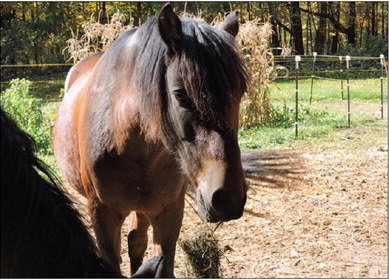
The horses When Loerzel and Coakwell were looking for a property, they hoped to find one that had a varied landscape. They were successful. The ponies graze between large trees, protected by shade but able to seek the sun when they want. The small horses are playful and act like human siblings as Loerzel walks among them distributing hay.
In July, a foal named Animikii (which means thunder in the Ojibwe language) was born, a fitting name since he was born during a thunderstorm. All of the ponies have Ojibwe names: Waabaanakwad (Grey Cloud), Dimii (deep body of water), Noojimo (She Heals), Ode’imini-giizis (Strawberry Moon), Mino Bimaadiziwin (A Good Life), Baswewe (Echo) and of course, Animikii.
“The horses are easy to get along with,” said a volunteer at the farm named Lute. “I feel comfortable with them and I miss them. I don’t have any of my own, so this allows me to be with horses.”
As Loerzel gave the horses hay on a sunny October day, she said none of them has a mean bone in their bodies.
“They’re curious. They’re small. They’re emotionally receptive, very laidback,” she said. “When I brought them here, it was like a little ceremony in itself.”
While expanding the herd and the number of these spirit animals across the nation is a goal, it can’t be done quickly or taken light- ly. And it's not Loerzel's first goal. Her first priority is giving the horses a good home and reconnecting them with their Ojibwe family.
“We’re really aiming to expand the herd in a safe and sustainable way,” Loerzel said. “We want to prevent genetic bottle-necking.”
For that very reason, The Humble Horse is also home to a Spanish mustang. Because the Ojibwe pony population is so small, inbreeding is a concern. Loerzel is also working with UW-River Falls professor Dr. Casie Bass and the equine program there on the best practices for reproduction. Mino, 2, is currently at the university’s breeding barn where they are trying to collect semen to freeze. Loerzel joked that he’ll get a diploma and graduation cap when he's finished. Another goal of The Humble Horse is to educate First Nations people about their heritage and share that knowledge with non-First Nations people.
“A lot of people don’t talk about race and humans,” Loerzel said. “We can use the horses to start that harder conversation. It’s not to make people feel guilty, which I think is a common misconception. It’s so we don’t repeat our past mistakes.”
When she was young, “red faces” were everywhere in logos, advertising and sports teams. It’s slowly getting better, but there’s still a lot of work to do, she said.
For people wanting to support The Humble Horse’s mission, donations are gratefully accepted. About $8 a day will feed the herd hay. Loerzel and Coakwell cover out-of-pocket expenses themselves, supported by grants and donations.
Just don’t ask Loerzel to sell the horses. “When people ask me if they can buy one of the horses, I tell them that it would be like if you saw someone selling your nieces and nephews,” Loerzel said. “You’d do everything in your power to get them back to where they belong.”
Visitors are welcome at the farm every third Saturday. To learn more or to donate, visit thehumblehorsewi.org

Humble Horse founder Em Loerzel with her husband River Coakley and one of their Ojibwe ponies. Photo courtesy of Em Loerzel