Board approves funding allocations PRESCOTT – The Prescott School District received some welcome news on Groundhog Day. It learned that it will receive about $650,000 in additional federal COVID-19 …
This item is available in full to subscribers.
To continue reading, you will need to either log in, using the login form, below, or purchase a new subscription.
If you are a current print subscriber, you can set up a free website account and connect your subscription to it by clicking here.
Otherwise, click here to view your options for subscribing.
Please log in to continue |
Board approves funding allocations
PRESCOTT – The Prescott School District received some welcome news on Groundhog Day. It learned that it will receive about $650,000 in additional federal COVID-19 relief funds. At the Feb. 16 school board meeting, Superintendent Dr. Rick Spicuzza outlined staff’s recommendations for those funds, which the board unanimously approved.
The budget for these funds must be submitted to the state by March 11.
According to the Wisconsin Department of Public Instruction, the ESSER III (Elementary and Secondary School Emergency Relief) Fund grant program authorized under American Rescue Plan (ARP) Act, provides additional money for local educational agencies (LEAs) to prevent, prepare for, and respond to COVID-19. ESSER III supplements ESSER I, created by the CARES Act in March 2020, and ESSER II, created by the Coronavirus Response and Relief Supplemental Appropriations (CRRSA) Act in December 2020.
See FUNDS, Page 8 FUNDS
From Page 1
PSD had initially been awarded $316,724 in ESSER III funds, but learned it would receive an additional $648,297 on Feb. 2, after the Joint Finance Committee approved the DPI’s and federal plan. Districts must first spend the money, then submit “claims” for reimbursement, Spicuzza explained. However, there are rules attached to the funds’ use.
“Anytime you get federal funds, there’s always strings and accountability attached,” Spicuzza said.
The funds are intended to help districts safely reopen and sustain schools’ safe operation, while addressing the pandemic’s impact on the nation’s students. However, because the JFC has “flat-funded” schools in the current biennium budget, the funds are also expected to fill in for operational dollars not provided by the state (which has a $3 billion surplus tucked away). Spicuzza explained the state has used the same funding formula for public education since 1993; this year, no budget increase was approved.
“So how do we refill our Fund 10 bucket that needs and is used for people, programs and performance?” Spicuzza asked.
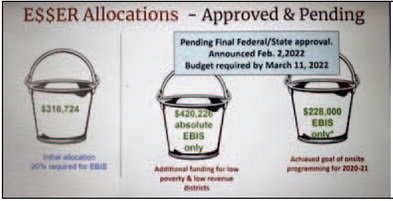
Twenty percent of the first “bucket,” which totals $316,724, must go toward Evidence Based Intervention Strategies, which are proven methods or programs that provide evidence showing they are effective at producing results and improving outcomes. However, 100% of the additional $648,000 must go strictly to people and programs (EBIS); no capital expenditures are allowed. “Bucket 2” totals $420,226, while “Bucket 3” totals $228,000. The third bucket goes to districts that achieved onsite programming in 2020-21, which PSD did with grades K5. Bucket 2 is additional funding for districts considered low-poverty and low-revenue. Only 155 districts in the state received additional funds.
The funds must be used to prevent, prepare for or respond to COVID-19. Some examples for preparedness include purchasing hand sanitizer or personal protective equipment, outfitting infrastructure to promote physical distancing, improving indoor air quality, or establishing a team to develop guidelines for infection control practices. ESSER funds can be used to address long-term school closures and continuity of learning plans, which may include additional staff to support virtual instructing or providing meals. For example, PSD spent nearly $50,000 of its fund balance to expand food provisions, providing food to families in need over the weekends, repackaging and purchasing additional supplies. It also used earlier ESSER funds to invest in Chromebooks for each high school students.
“Was it the perfect solution?” Spicuzza asked of the Chromebooks. “Absolutely not. Did it at least keep a continuity of learning? We believe it did.”
‘Bucket’ allocations
Twenty percent of Bucket 1 must be used to implement EBIS to address learning loss caused by the pandemic. It will be used for summer learning or summer enrichment, extended day or comprehensive after-school programs, and extended school-year programs dictated by Individualized Education Programs (IEP). Districts must make sure that interventions respond to student’s social, emotional and academic needs and address the disproportionate impact of COVID with an additional eye toward underrepresented student subgroups.
The newly awarded money (Buckets 2 and 3) cannot be used to address capital projects whatsoever; 100% of these funds must address operational costs that were not funded by the Wisconsin Legislature and are to be used for EBIS. The money can be used for personnel who address student achievement or mental health needs, staff training, intervention materials and purchased services.
In Prescott, underrepresented subgroups specifically mentioned in US Department of Education guidance as likely to have been disproportionately affected by COVID are children with disabilities or children from low-income families. There are much larger gaps seen in these groups in grades 6-12 than in elementary school.
According to Sprin 2021 state assessment data, special education students were most affected in grades 6 and 8-11 in English/language arts and in math grades 7-11. The same applies to free and reduced lunch students in grades 7-11 in English/language arts and in grades 7-11 in math. Secondary students (middle/high) experienced decreased academic performance relative to the elementary schools, which were kept open.
Funds can also be used for outreach and services for special populations. This can include professional development for staff to serve students with disabilities, paying staff to teach parents and students with IEP technology, mental health services and support, additional schoolbased mental health staff (counselors, psychologists or social workers), peer-to-peer suicide prevention and mental health literacy programs, or Chromebooks for the middle school.
Staff recommendations
The board approved the staff’s recommendations for the funds’ use. For Bucket 1 ($316,000):
•Instructional materials for the new EBIS K5 literacy reading program – $105,000 (this includes ongoing expenses through 2024)
•Instructional materials for K-12 EBIS math – $152,000
•CESA 11 literacy professional development for grades 6-12 – $10,000
•EBIS instructional software for credit makeup, alternative learning center, and homebound students
•Mental health screener, Family Means, onsite student assistance and outreach programs
•The local Fastbridge Assessment System for 4K-12 used to monitor achievement and growth in reading and math to evaluate the effectiveness of core instruction and interventions “One of the most challenging things is not just the front end of trying to allocate the dollars, but going back to the Joint Finance Committee and saying ‘Make sure, given that we are zerofunded for this year and next year, we have a lost of stress on Fund 10,’” Spicuzza said. “These are all critical, core components, making sure our students are getting a good education … and that it’s able to meet students at all levels.”
For Bucket 2 ($420,000), $120,000 will go toward a 3.5-year lease for PHS 1:1 Chromebooks. A similar contract is recommended for PMS students starting in Fall 2022; a three-year lease will cost $100,000. This would also free up two classrooms at PMS that are currently designated as computer labs. If each student has their own Chromebook, the labs wouldn’t be needed.
Also, $200,000 will be allocated to covering summer session programs for 2021-24. This would help refund and rehydrate Fund 10 (which pays for staff salaries). Spicuzza labeled summer programming as “vital,” because more ground is lost in math over the summer, for example, than in reading. The district also wants to bring back Prairie Fire Theatre for students.
Bucket 3 ($228,000) will be used for increasing full-time staff by four across the four schools and adding two more aides. The four have already been added: A math and literacy interventionist at Malone Elementary, a literacy coach at Malone Intermediate, a math interventionist at Malone Intermediate/PMS, and a special education teacher at PHS. Money would also be reinvested in the additional hours of all hourly staff.
Spicuzza said the hope is that funding from the state kicks in in the next biennium budget; the ESSER funds give districts “breathing room as we build next year’s budget.”
Freeing up Fund 10 dollars can allow the district to hire more interventionists or buy more materials, to be more flexible and responsive to student needs.
Board President Mike Matzek shared that designating any ESSER funds to an eligible capital project, such as the needed air handler at Malone Elementary, wouldn’t be beneficial, considering that project is well over $1 million. Many community members have raised the question, why can’t ESSER funds be used to fund big capital projects?
“It (ESSER) would cover very little,” Matzek said. “It would put us in a precarious position because funds are reimbursed once spent. We don’t have that money up front.”
Board Treasurer Pat Block said it’s his personal opinion that spending ESSER funds on capital projects is not the right thing to do, even if it were allowed.
“I think even if there was a way, to kind of, take care of some of those costs with these dollars, I don’t think it’s appropriate,” Block said. “I think these dollars are for a very specific reason, and even though there may be a loophole, if you will, to try to do it, I personally just don’t think it’s appropriate. It needs to be spent without our people and on education.”
This graphic shows the approved and pending ESSER funding allocations for the Prescott School District. PSD is receiving an additional $648,297, announced Feb. 2. Graphic courtesy of Prescott School District
This graphic represents the hardship placed on school districts by the state’s decision to “flat fund” education for the next two academic years, with a $0 increase in state funding. Graphic courtesy of Prescott School District