Residents speak out against ‘RF Racetrack’ By Sarah Nigbor RIVER FALLS – The River Falls City Council Aug. 10 approved the first reading of several amendments to ordinances and city code …
This item is available in full to subscribers.
To continue reading, you will need to either log in, using the login form, below, or purchase a new subscription.
If you are a current print subscriber, you can set up a free website account and connect your subscription to it by clicking here.
Otherwise, click here to view your options for subscribing.
Please log in to continue |
Residents speak out against ‘RF Racetrack’
By Sarah Nigbor
RIVER FALLS – The River Falls City Council Aug. 10 approved the first reading of several amendments to ordinances and city code related to parking, public nuisances, rental uses, signage, and code enforcement, with some modifications since they were first presented at the July Plan Commission meeting. For one thing, residents don’t have to rush out and build a fence to screen their RVs.
City Planner Emily Shively said city staff have been working with Larry Kirch of Prologue Planning to update and consolidate city code and ordinances after receiving city council direction to do so in June 2021.
Parking of vehicles on private property is one of the city’s most common resident complaints.
“It’s been determined that the current ordinance doesn’t adequately address a number of issues related to parking on residential properties,” Shively said. “This has resulted in resident complaints and conflicts with utility location and stormwater management.”
For example, Shively said, there’s no setback requirement stating how close to a property line you can pave a driveway or park or store a vehicle. A resident could pave or park up to the property line, resulting in inadequate room for utilities, stormwater, snow storage and may create encroachment issues with neighbors.
Vehicles need to be parked on an improved surface, such as asphalt, concrete, brick or another dust-free surface and not on grass or another landscaped area. When vehicles aren’t parked on an appropriate surface, yards can become rutted and erosion may occur, which negatively impacts surface water quality, she said.
This also applies to RVs, boats, equipment trailers, etc.
“The proposed amendment would require that parking and driveways be located at least five feet from the property line and not within a drainage and utility easement,” Shively said. “This allows for free-flowing drainage, installation and maintenance of utilities and separation between parking areas on adjacent properties.”
As a result of the July 5 Plan Commission discussion, a few modifications have been recommended. Staff had initially recommended that boats, RVs, and other equipment that is stored in a side or rear yard on residential property be screened from public view by an opaque fence or wall with gate access. The Plan Commission worried that this might be too expensive for some people to implement.
“Staff has removed the screening requirement; however, we’re still recommending that all vehicles be parked at least 5 feet from a side property line and on an improved surface, even if that’s simply pavers under the wheel areas to be consistent with other parking performance standards and to address common resident complaints,” Shively said.
The ordinance amendment had also recommended that these vehicles be allowed to be parked on a driveway for only 72 hours to limit obstructions in the front yard. This provision has been removed. Staff are recommending a 30-day requirement remain in effect.
The provision prohibiting backing RVs into a driveway has also been removed, for safety reasons. It’s easier to drive an RV straight out of a driveway than back it into the street.
“The intention was for the license plate and tabs to be visible,” Shively said. “Still a tarp or vehicle cover is not allowed to hide the license plate.”
Public nuisances
“The proposed code amendments would address maintenance of exterior property and premises with specific examples of what is considered inappropriate and hazardous to store openly in the yard, such as appliances, household garbage, televisions, things like that,” Shively said.
It also prohibits improper disposal or dumping of trash and moving it from one property to another.
The ordinance is meant to prevent inoperable vehicles from taking up parking spaces or becoming increasingly deteriorated, creating unsafe and unsightly conditions.
Rental uses
“Recent state law changes have impacted how cities are able to regulate and inspect rental properties,” Shively said.
In the past, the city had an annual rental licensing program that allowed the building inspector to identify potential health and safety issues on a regular basis, to ensure adequate maintenance and upkeep of rental properties. Current law only allows cities to have a required inspection program in areas that are designated as blighted.
To ensure that basic habitability standards are met in all residential properties, the proposed ordinance amendment adds language to the zoning ordinance.
It amends the housing code to address habitability violations per state statute.
Clarifies residential rental registration and complaint and enforcement procedures to ensure the health and safety of residential housing units in a manner consistent with state statutes.
Adopts state codes and statutes by reference for contractor licensure requirements, Electrical Code, Uniform Dwelling Code, Commercial Building Code and Plumbing Code.
Requires licensure of plumbers and electricians who work in the city, consistent with state law.
Defines rental income and residential rental uses; this allows for additional enforcement of rental property via performance standards of the zoning code.
Classifies residential rental uses as a permitted use in all zoning districts that allow residential uses Establishes minimum space and occupancy standards for rental uses to be consistent with the building code and subject to requirements in the housing code. This establishes minimum space needs for bedrooms and living areas so that landlords can’t designate a closet, attic or garage space as a bedroom unless those spaces meet the minimum building code standards for light, ventilation and egress, plus minimum floor and ceiling heights.
Signage
In a recent Supreme Court case, the court determined that signage may be regulated with regard to location, manner and duration, but not on the content or the message of the sign, Shively said. “This means that all signs must be regulated in the same way, and you cannot regulate a sign based on what it says,” she added.
The issue this has created in River Falls relates to signs in the right-of-way. The ordinance currently allows garage sale and real estate directional signs to be located in the right-of-way for a limited amount of time. However, the court decision means that all signs (political and commercial) must now be allowed in the right-ofway. Signs have been placed in unsafe or inappropriate locations.
The amendment will prohibit all signs, except traffic, in the right-of-way. The exception is sandwich boards at downtown businesses.
All signs will be required to be on private property, which means people will need to get permission from property owners before sticking a garage sale sign at the corner. Signs must also be 15 feet from the road.
Duration regulations for political signs have been removed to comply with state law, Shively said.
Enforcement
“If a property achieves compliance at any time during the process, the case is closed and no further action needs to be taken,” Shively said.
The new process outlined (in the graph) provides clear and consistent enforcement procedures.
“We are setting some standards,” Alderperson Diane Odeen said. “We haven’t had consistent standards that have addressed some of the complaints that we’ve gotten.”
The city will devote half an FTE employee to code enforcement, City Administrator Scot Simpson said. That person will “more easily” address problem properties, which equates to roughly 100 out of 6,000.
“What we’ve understood is, the city has generally taken a more laissez-faire approach to private property and code enforcement and the council has indicated that the community said they wanted to take a more proactive approach and set some community standards around specific things,” Simpson said.
The city will not be operating on strictly a complaints- based system, but rather will take a more methodical, proactive approach. However, it won’t be overzealous.
“This is not a super proactive, regular rounds, we didn’t add a vehicle to the fleet,” Simpson said. “We’re not setting up a whole code enforcement department.”
During the public hearing, Kennedy Street resident Chris Gagne asked for clarification on whether existing properties with driveways up to property lines will be grandfathered in. The answer is yes.
Shively explained the amendments mean “from this day forward, these are the regulations going forward for anything that is new. Anything already in place can remain. You are allowed to maintain and replace.”
Proposed racetrack
Elizabeth Bowden, a resident of Clark Street, began the public comment portion of the meeting by asking alderpersons to focus on “fair housing for all” rather than a high-end automotive country club/race track proposed by developer Neal Krzyzaniak.
“I would like to encourage you to discourage community development time, money and staff resources continuing to be spent on development, such as the proposed race course community east of town … It’s important that we remember that children are the future of this community.” She added she would like to see community development focused on maintaining fair housing for all and for sustainability to play out in practice.
Next up to the mic was Don Leake, a Birchcrest Drive resident who has lived in town for 39 years. He is also a member of the Stop the River Falls Race Track Coalition. He spoke about the July 20 meeting between residents and the developer at the Unitarian Universalist Society which kicked off a movement to stop the 500-plus acre development east of town.
“You, all of you, have had a chance to view this recorded presentation and the subsequent Q& A session, along with the concept plan map,” he said.
He said he knows Administrator Scot Simpson emphasized that the city hasn’t received anything official regarding the 500+ acres.
“Nevertheless, I think it’s important that public record be made before this council of a couple of telling comments made by Neal about his development project, which now appears to have a name: River Falls Motorplex.
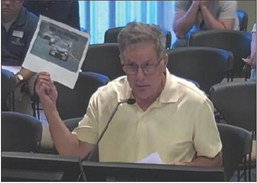
“During the meeting, more than once, Krzyzaniak insisted his development was not a race track, yet the very first bit of advertising launched for the project is this image (held up by Leake) … Neal stated that he had multiple meetings with the city, DNR and county to discuss all sensitive issues, and toward the end of the 20-minute presentation added ‘The meeting that we had with the city, with the county, with the DNR, we had a lot of good favor on our side, a lot of good favor on our side.’ This last statement is most troubling to me as it indicates that Krzyzaniak feels that he has been encouraged to proceed with an annexation petition.”
Leake said he’s not in favor of the development for numerous reasons, but it doesn’t meet any present need for the city, conflicts with the land’s designation in the City of River Falls’ future land use map, threatens a sensitive ecosystem and does not fit the character of River Falls as he sees it.
“I would not embrace this change,” he closed.
According to Alderperson Diane Odeen, who posted on social media Aug. 18, Krzyzaniak told city staff he is no longer considering the “motorplex” development because it’s clear the community doesn’t want it. Instead, he will allegedly consider a housing development.
River Falls resident Don Leake speaks out against the proposed River Falls Motorplex at the Aug. 10 River Falls City Council meeting. Photo courtesy of City of River Falls
This table shows the steps the City ofRiver Falls will follow for code enforcement and compliance. Table courtesy of City of River Falls